Castle Garden
The EmigrantsCastle Garden is a round, yellow-gray building with a large tower, glimpsed from the Charlotta as the emigrant ship approaches New York. The Finn identifies it first as a former prison and then as a crowded saloon, and Robert interprets that change through his idealized picture of America: even a place called a prison, he concludes, has become an inn where people are free to enjoy themselves. The building turns arrival into a test of expectation, exposing the gap between the emigrants’ imagined New World and the fragment they can actually see from the ship.
Appearance and Arrival
As the mist lifts from New York Harbor, the Charlotta steers toward a shore crowded with fortifications and piers. Among them stands Castle Garden, conspicuous for its round, yellow-gray mass and tremendous circular tower. The sight belongs to the emigrants’ first view of the city, whose houses, churches, streets, people, and carriages appear on a scale beyond anything they have known. But the harbor is not yet a settled destination: the passengers are still aboard the ship, looking toward a land they have crossed the ocean to reach.
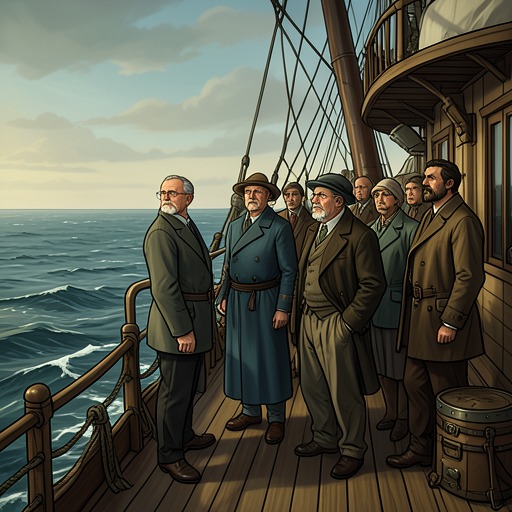
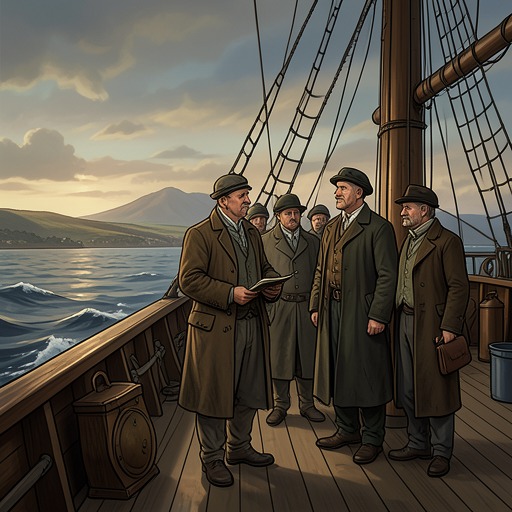
Robert and Arvid stand at the prow beside the second mate, the Finn, who has made every one of the Charlotta’s North American voyages. Robert wonders what the imposing building is, but does not want to ask. Arvid asks instead, and the mate supplies the word Castle Garden, adding that a kastell is the same as a prison. The unfamiliar term and the building’s appearance make the explanation immediate but disquieting: Robert had not expected the first American house he saw to be a place where people were locked up and lost their freedom.
The Finn’s Explanation
The Finn corrects the first impression by explaining that Castle Garden is no longer used as a prison. It is a saloon, and he speaks from personal experience: the food is good, the ale excellent, and visitors can eat and drink to their satisfaction. On Sundays, he says, it is so crowded that people sit on one another’s knees. His account makes the building less a symbol of incarceration than a place of noisy, unrestricted pleasure, where a brawl and knife use are among the entertainments he describes.
The explanation is comic in its collision of scales. Castle Garden’s formidable tower and prison associations give way, in the Finn’s account, to the practical details of food, ale, crowds, and fighting. Yet the mate is also the passengers’ guide to a place they cannot interpret for themselves. From the deck, the emigrants see an unfamiliar city; what that city means reaches them through brief, sometimes partial explanations from someone who knows the harbor.
Robert’s Interpretation and the American Ideal
Robert accepts the Finn’s distinction in a way that reveals more about his hopes than about the building. If Castle Garden was a prison but is now a saloon, he reasons, then American prisons are not really prisons in the Swedish sense: they are fine inns, full of guests free to entertain themselves. From this mistaken conclusion he draws a confident verdict about America’s government. A single building, encountered at the threshold of arrival, becomes evidence for the whole country’s supposed kindness and liberty.
That inference gives Castle Garden its narrative significance. The emigrants’ crossing has been measured in hardship and delay, while America has remained distant and imagined; now the first recognizable structure they meet is at once a former prison and a place of recreation. The contrast lets Robert preserve his belief in the new land by turning even the word prison into reassurance. At the same time, the scene leaves his confidence exposed as a product of scant information: the Finn has described one building, but Robert has made it stand for an entire society.
A Threshold in the Harbor
Castle Garden appears during a collective moment of anticipation. Before long, all the Charlotta’s passengers have gathered on deck to see America, carrying or helping those who cannot climb up by themselves. They look across the harbor at the built shoreline, but their eyes are also searching for greenery; beyond the large tower, the lifting mist eventually reveals trees and grass. The scene thus moves from the monumental, human-made face of the port toward the signs of land and vegetation that the emigrants have longed to see.
The building is not presented as a place the passengers enter. Its importance lies in being seen and interpreted from the ship, at the moment when arrival is still an expectation rather than an experience on shore. Castle Garden condenses that unstable first encounter: a prison becomes a saloon in the Finn’s account, and a saloon becomes, in Robert’s hopeful reasoning, proof of a benevolent country. The novel makes the emigrants’ new beginning vivid not through settled knowledge of America, but through the meanings they attach to what first rises out of the harbor mist.